19/03/2026
A study by the Politecnico of Turin, carried out at Giacomini’s request, analyzes real cases of residential buildings renovated under two different energy retrofit scenarios and demonstrates how the integration of low thermal inertia radiant systems with insulation improves both the energy rating and the property value.
In today’s building renovation context, the system can no longer be considered merely a cost item. Energy performance, consumption, emissions, comfort, and indoor air quality are now factors that directly impact a building’s economic value and its attractiveness on the real estate market.
Starting from this premise, the Polytechnic University of Turin developed a study based on a real residential building energy efficiency case, aimed at evaluating the economic, financial, and environmental impact of different construction and system design choices.
The study was developed with a clear objective: to demonstrate how an integrated system approach, based on the combination of:
envelope improvement measures of varying intensity
low thermal inertia radiant systems combined with heat pumps
can have a measurable impact on:
energy performance
indoor comfort
overall property value
Starting from the building’s existing conditions and related energy consumption, the study compares two different outcomes, each corresponding to a different retrofit scenario:
the first characterized by a stronger focus on insulation measures
the second aimed at identifying the optimal balance between insulation level and the most appropriate radiant system
Both scenarios were assessed in two different Italian locations—Turin and Bari—in order to account for the country’s significant climatic variability and ensure that the results can be extended to intermediate climate zones as well.
Building envelope
External wall insulation system, thermal conductivity 0.033 W/mK
Insulation on the upper side of the ceiling facing the attic
Insulation beneath the radiant floor system
New external windows and doors
Systems
Radiant floor system with additional insulation panel only on the ground-contact floor
Heat pump for heating, cooling, and domestic hot water, with 2 storage tanks
Dehumidification system
Photovoltaic panels
Climate zone: D
Building envelope
External wall insulation system, thermal conductivity 0.033 W/mK
Insulation on the upper side of the ceiling facing the attic
Insulation beneath the radiant floor system
New external windows and doors
Systems
Radiant floor system with additional insulation panel only on the ground-contact floor
Heat pump for heating, cooling, and domestic hot water, with 2 storage tanks
Fan coil units for cooling
Photovoltaic panels
Climate zone: C
Building envelope
Insulation on the upper side of the ceiling facing the attic, thermal conductivity 0.033 W/mK
Insulation beneath the ground floor slab with lightweight screed
New external windows and doors
NO external wall insulation system
Systems
“Spider” radiant floor system installed over the existing floor
Retention of the existing ground slab, with the addition of a lightweight sub-base screed using expanded clay and installation of a Giacomini radiant panel
Heat pump for heating, cooling, and domestic hot water, with 2 storage tanks
Dehumidification system
Photovoltaic panels
Building envelope
Insulation on the upper side of the ceiling facing the attic, thermal conductivity 0.033 W/mK
Insulation beneath the floor slab
New external windows and doors
NO external wall insulation system
Systems
“Spider” radiant floor system installed over the existing floor
Retention of the existing ground slab, with the addition of a lightweight sub-base screed using expanded clay and installation of a Giacomini radiant panel
Heat pump for heating, cooling, and domestic hot water, with 2 storage tanks
Fan coil units for cooling and dehumidification
Photovoltaic panels
The analysis methodology is based on a strategic comparison between individual energy retrofit measures and integrated, comprehensive interventions.
The study considers the two-year period 2026–2027, based on the regulations available at the time of writing and the preliminary provisions of the 2026 Budget Law, taking the primary residence scenario as a reference in order to assess its impact on investment optimization.
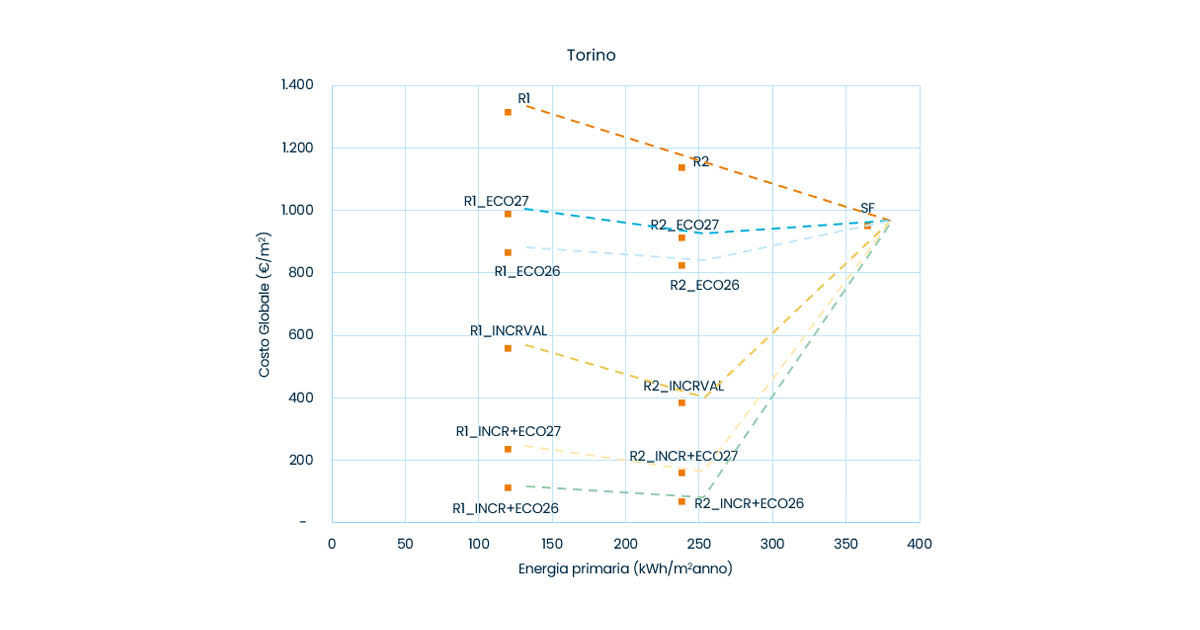
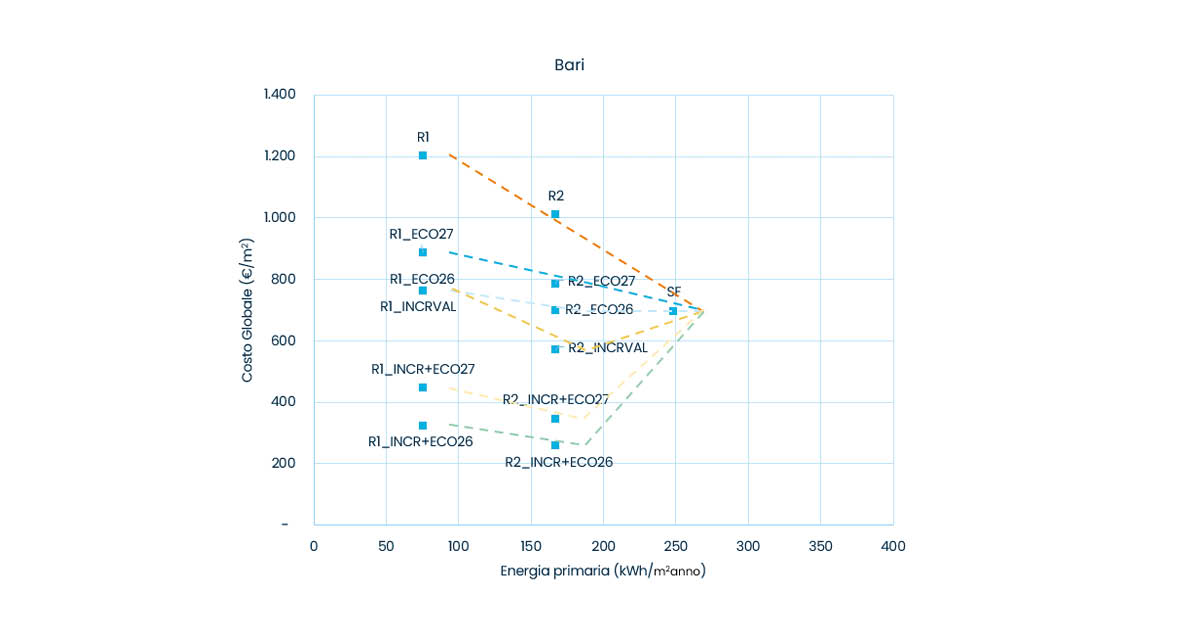
The analysis of discounted global costs over a 30-year horizon reveals a significant transformation in the economic structure between the existing conditions and the retrofit scenarios.
In the existing state, the cost structure is simplified and dominated by operating costs: 89.9% in Turin and 90.4% in Bari.
The retrofit scenarios reverse this logic, concentrating 55–65% of total costs in investment categories: retrofit construction works (24–37% of the total), new systems (21–27%), and design (7–9%). Operating costs are drastically reduced to 7–17% of the total global cost.
Maintenance costs become more significant in the retrofit scenarios (9–12% vs. 6% in the existing state), reflecting the increased system complexity.
Replacement costs account for 11–12% of total retrofit costs, highlighting the need for planned technological upgrades.
The analysis is based on econometric models applied to real market data sourced from Wikicasa.it (year 2025). The Turin sample includes 65 properties, while Bari includes 69 properties, both focused on single-family homes.
Upgrade from Energy Class F to A (5 class jumps)
Premium per class jump: +5.63%
Total increase F→A: +28.15%
Upgrade from Energy Class G to A (6 class jumps)
Premium per class jump: +6.69%
Total increase G→A: +40.14%
In the absence of incentives or property value enhancement, payback periods are particularly long: in Turin, they range between 26.8 and 31.5 years (R2–R1), while in Bari they range between 37.1 and 43.1 years (R2–R1).
With the introduction of the tax incentives planned for 2026, distributed over 10 years, the net investment is reduced. In this scenario, the payback period decreases to 13–16 years for Turin and 19–22 years for Bari.
Under the 2027 tax incentive scenario, also over a ten-year period, payback times increase to 17.2–20.2 years for Turin and 23.7–27.6 years for Bari.
Considering only the increase in property value, in Turin scenario R2 shows an immediate payback, with a negative net investment, while scenario R1 records a payback period of 8.23 years. In Bari, payback periods range between 14.2 and 24.2 years (R2–R1).
By combining 2026 incentives with property value appreciation, both R1 and R2 in Turin show immediate payback, with negative values of –7 and –15 respectively. In Bari, the payback period is 3 years for R1 and immediate for R2 (–4).
Finally, under the 2027 incentives combined with property value increase, Turin confirms immediate payback for both scenarios (–3 for R1 and –11 for R2), while in Bari the investment is recovered in 9 years for R1 and 1 year for R2.
The two case studies demonstrate that, in residential energy efficiency interventions, the appropriate combination of:
low thermal inertia radiant systems with heat pumps
building thermal insulation
window replacement
represents a key strategic choice to achieve a significant and tangible increase in the value of the property being renovated.
Indeed, the objective is not only to reduce energy consumption and emissions, but also to enhance the overall value of the building by improving its energy class, indoor comfort, and user experience, thereby contributing to the overall energy performance of the national building stock.
This study, developed jointly by the Polytechnic University of Turin and Giacomini S.p.A., and based on real data supported by rigorous numerical validation, demonstrates how an integrated system approach represents a concrete solution fully aligned with the decarbonization goals of the real estate sector, capable of effectively addressing the current needs of the building renovation market.